Foam Futon Mattress Guide
Latex Layers for Foldaway Guest Beds: Comfort, Fit, and Care
A foldaway bed can be a welcome surprise for overnight guests—provided it feels like a place to sleep, not a clever storage solution with a sheet on top. A latex layer may add cushioning and responsive support, but the right choice depends on more than softness. Thickness, dimensions, flexibility, storage habits, and care instructions all matter when the mattress has to fold away again.
Here’s how to weigh latex against memory foam, choose a suitable sleep surface for a futon or foldaway guest bed, and keep your setup comfortable without asking it to do something its construction was never designed to do.
Start with the bed’s job, not the material
A mattress for a futon may need to perform two very different roles. During the day, it could be folded, tucked into a frame, or stored in a closet. At night, it needs to provide a reasonably even surface for rest. A topper that feels wonderfully plush when laid flat can become awkward if it resists bending, shifts around, or takes up more storage space than expected.
Before comparing foam futon mattress options, consider how often the bed will be used. An occasional guest bed has different demands from a futon that serves as someone’s nightly mattress. Infrequent use may make convenience and compact storage the priority. Regular use puts more emphasis on support, resilience, and whether the base itself is appropriate for long-term sleeping.
It also helps to separate two questions: “Would a topper make this surface more comfortable?” and “Can this topper safely and practically be folded with this bed?” The first is about feel. The second is about fit and construction. A good answer to one does not automatically answer the other.
Latex and memory foam: two different kinds of comfort
Latex and memory foam are both used in sleep products, but they tend to respond differently under the body. Latex is often described as buoyant or springy. It compresses under pressure and rebounds readily when that pressure is removed. This can create a more lifted, responsive sensation, with less of the slow-sinking feel commonly associated with memory foam.
Memory foam typically contours more gradually around pressure points. Some sleepers appreciate that close, cushioned feel; others prefer a surface that changes shape more quickly as they move. Neither material is automatically better for every person or every futon mattress. Feel depends on the particular foam formulation, its firmness and thickness, the cover, and the surface underneath.
Latex also comes in different constructions and firmnesses. Natural latex, for example, can be made using different processes, including Talalay and Dunlop methods. Product descriptions may identify the process, firmness, cover materials, and total height. Those details are more useful than assuming every latex layer behaves alike.
If you are comparing materials for a foldaway guest bed, think beyond a quick press of the hand. Ask how the layer responds when someone shifts position, whether it adds too much height for the frame, and whether the manufacturer permits folding or repeated bending. The materials’ general feel is only one part of the decision.
The folding question: flexibility has limits
Foldaway beds come in many designs: hinged futon frames, tri-fold mattresses, sofa beds, roll-up floor mattresses, and portable guest cots. Their hinges, seams, and storage arrangements vary. A foam pad intended to lie flat on a bed is not necessarily made to bend repeatedly at a frame’s joints. Latex can flex, but that does not mean every latex topper is suitable for being folded, compressed, or stored in a tight curve.
Repeatedly forcing a layer to fold where it is not designed to bend may strain the material, its cover, or the seams. A thick topper can also make a folded mattress bulky, interfere with the frame closing, or cause the sleep surface to shift. Check the care and use instructions for both the bed and the topper. If they do not say that a layer can remain on the mattress while it folds, do not assume that it can.
For a removable layer, the simplest routine may be to take it off before putting the bed away and store it flat or in the manner the manufacturer recommends. That adds a step, but it avoids turning the topper into part of a folding mechanism it may not be built to withstand. If easy, one-motion storage is essential, a separate topper may not be the most practical answer.
Quick check: Open and close the bed without bedding first. Then compare the frame’s folded dimensions and clearances with the topper’s actual dimensions and thickness. When in doubt, ask the manufacturers rather than testing a tight fold repeatedly.
Thickness affects comfort, fit, and storage
Thickness is one of the easiest specifications to notice—and one of the easiest to overvalue. A deeper layer may change the feel of a firm futon mattress, but it also adds height and bulk. On a sofa bed, that extra height could affect whether the seat closes properly. On a folding floor mattress, it may make the folded bundle harder to carry or store.
A thinner foam pad can be easier to handle and may make a modest difference to the surface. A thicker layer can make a more noticeable change, but it may also sit less securely on a flexible or uneven base. The ideal thickness is therefore not a universal number. It is the amount that suits the sleeper while still working with the mattress, cover, frame, and storage space.
Measure the available sleeping area instead of relying on names such as “full” or “queen” alone. Futons and foldaway frames can vary from standard mattress dimensions, and an overhanging topper may bunch or slide. Record the flat surface’s length and width, then check the topper’s listed measurements. Also measure the folded unit and the place where it will be kept.
- Measure the sleep surface: Include the usable flat area, not just the frame’s outside dimensions.
- Check thickness carefully: Account for the topper and mattress together when assessing frame clearance.
- Think about handling: Consider whether one person can lift, fold, or store the complete setup comfortably.
- Check the cover: A fitted cover may need to accommodate the combined height without compressing or distorting the layers.
Fit is more than matching a mattress label
A topper that is too small leaves exposed areas and can move during the night. One that is too large may wrinkle at the edges or interfere with the bed frame. Exact measurements matter especially when the base is an older futon, a custom-size guest bed, or a sofa mechanism with a narrow clearance.
Measure the mattress in its normal sleeping position, including width and length. If its edges slope or the surface changes shape when opened, note that as well. A topper is generally intended to sit on a stable, flat support; it cannot reliably correct a sagging base, broken slats, or a hinge that creates a pronounced ridge.
Think about how the layers will stay together. A fitted cover, compatible mattress protector, or other manufacturer-approved method may help reduce shifting. Avoid solutions that create a tight, uneven surface or obstruct the folding hardware. If the bed needs to close with the topper in place, confirm that the combined setup is designed for that use—not simply that it seems to fit once.
When a latex topper may make sense
For someone who wants a more responsive feel than a slow-contouring foam surface, latex may be worth considering. It can add cushioning to a firm, flat mattress while retaining a springier feel. People who move around during sleep may also prefer a surface that responds quickly, though personal comfort varies and no material guarantees better sleep for everyone.
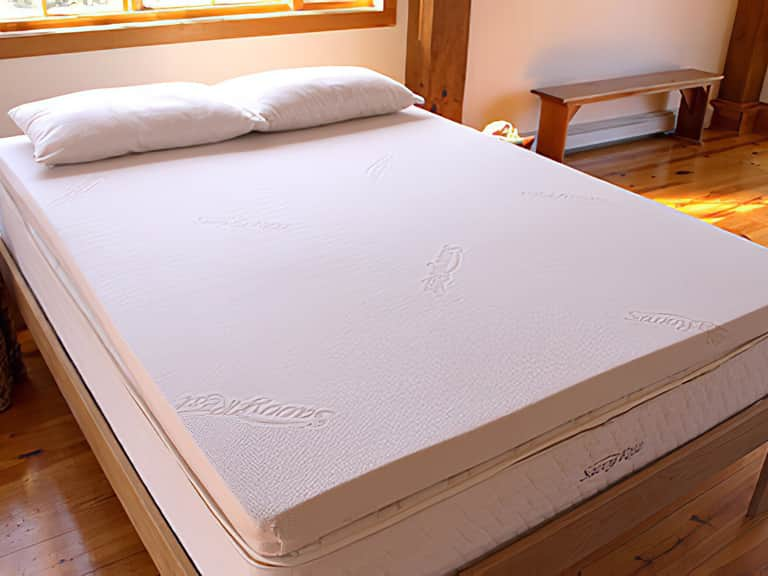
A three-inch Talalay latex topper, such as the Savvy Rest Vitality Latex Mattress Topper, illustrates the kind of specifications to examine: it is described as a soft, three-inch natural Talalay latex layer with a certified organic cotton stretch-knit casing. That thickness may be relevant to someone assessing added cushioning, but it also makes checking the bed’s dimensions, storage plan, and folding instructions particularly important. The listed description does not establish that it should be folded with a futon or stored in a bent position.
This distinction matters: a product can be a latex mattress topper without being a foldaway-bed accessory. Treat the topper as a separate layer unless its instructions expressly support the intended use. Confirm compatibility before relying on it for a bed that must fold every day.
When memory foam may be the better match
Memory foam may appeal to a sleeper who likes a closer, more enveloping contour. A foam pad for a futon can soften the initial feel of a firm base, but its thickness and density influence how it feels and how easily it can be handled. Some memory foam responds slowly, which may feel relaxing to one guest and restrictive to another.
Temperature is another consideration. Foam products differ in how they manage warmth, and claims such as “cooling” should be interpreted as product features—not a promise that every sleeper will feel cool through the night. Room temperature, bedding, the cover, and the sleeper all influence comfort.
As with latex, check whether the memory foam product is intended to be folded or repeatedly flexed. A flexible-feeling foam is not necessarily designed for a hinged bed. Compare the manufacturer’s care guidance with the bed’s folding method, and do not bend a layer sharply unless the instructions allow it.
Care starts with ventilation
Foam and latex layers benefit from sensible housekeeping. Moisture can become trapped between a topper and its base, particularly when a foldaway bed is closed soon after use. When practical, open the bed and let the layers air before folding them away. Keep the room ventilated and avoid putting damp bedding on top of the mattress.
Use a removable, washable cover or protector only if it is compatible with the topper and does not interfere with the way the bed folds. Follow the care label: a removable cover may be washable while the foam core is not. Many foam layers should not be soaked or put in a washing machine. For spills, follow the manufacturer’s cleaning instructions and allow the surface to dry fully before making the bed or storing it.
Regularly inspect the sleep surface and frame. Look for shifting layers, torn covers, persistent dampness, unusual odors that do not clear with airing, or visible changes in shape. A topper is not a fix for structural problems in the bed beneath it. If the base is sagging or damaged, address that before adding another layer.
- Air the bed after use when the room and schedule allow.
- Keep the layer dry and store it as directed by its manufacturer.
- Clean only in the manner stated on the care label.
- Inspect hinges, slats, seams, covers, and mattress edges periodically.
A useful decision checklist
Choosing between latex, memory foam, or the existing futon surface becomes easier when the questions are practical. Before committing, consider the following:
- How often will the bed be used? Occasional visitors and nightly sleepers place different demands on a guest setup.
- What feels comfortable? Decide whether the sleeper prefers buoyant responsiveness or closer contouring, while remembering that individual experience varies.
- Does the layer fit? Measure the mattress and compare dimensions rather than relying on a size name.
- Can the bed still fold? Check frame clearance and written instructions for both products.
- Where will it be stored? Plan for its full size and weight, and use the recommended storage position.
- How will it be protected? Choose compatible bedding and understand which parts can be washed.
- Is the base sound? A topper may change surface feel, but it cannot repair a damaged frame or an uneven mattress.
The comfortable guest bed is the one that fits real life
A foldaway bed has to work when it is open and when it disappears. Latex can offer a responsive alternative to the slower contour of memory foam, while a well-chosen foam futon mattress or topper may add useful cushioning. But material preference alone cannot settle the question. A layer that is too thick, too large, or unsuited to repeated folding may create more hassle than comfort.
Measure first, read the care guidance, and treat folding compatibility as a firm requirement rather than a hopeful assumption. If the topper must be removed before storage, decide whether that routine is realistic. If the bed needs to close in one step, look for a sleep surface specifically approved for that arrangement.
With those details sorted, the choice becomes less mysterious. Match the feel to the sleeper, the dimensions to the frame, and the care routine to the way the room is used. The result is a more considered guest bed—and a softer landing when company arrives.
Frequently asked questions
Can I leave a latex topper on a futon when I fold it?
Only if the instructions for the topper and futon both allow that use. Latex can flex, but that does not establish that a particular topper is made for repeated folding or storage in a bent position. When guidance is unclear, remove the layer and store it as directed.
Is latex more supportive than memory foam?
They provide different sensations rather than a universal ranking. Latex is commonly associated with buoyant, responsive support, while memory foam is known for closer contouring. Firmness, construction, thickness, and the surface underneath all affect the experience.
How thick should a foam pad for a futon be?
There is no single ideal thickness. Consider the existing mattress, the sleeper’s comfort preferences, frame clearance, and the space available for storage. A thicker layer changes the bed’s overall height and can make folding more difficult.
How can I keep a foldaway guest bed fresh?
Air it when possible, keep its layers dry, use compatible washable bedding, and follow the manufacturer’s cleaning instructions. Let damp components dry completely before closing or storing the bed.